Promise to preparation
Shared contract: availability, acceptance and order status.
Failure to investigate: the customer is confirmed while the store cannot fulfill.
Readiness evidence: unavailable-item, rejection and cancellation paths.
CASE STUDY 01 / BAKOME
Product ownership from discovery through public launch across the customer, store owner and driver experience.
MARKET DISCOVERY / ON THE GROUND
Our market research was primarily on the ground. The expansion plan included BakOme representatives in each identified community, creating a local presence as we expanded.
Delivery time depended on the balance between available drivers and orders at any given time. Customer demand alone was insufficient to ensure a reliable delivery experience.
Community research, the representative expansion plan and the driver/order imbalance are reported experience. Capacity checks and the quantitative model below are proposed ways to evaluate that constraint.
Capacity = available drivers × deliveries per driver-hour. Example: 12 incoming orders versus capacity for 8 means demand is 150% of capacity. This simplified steady-rate model excludes geography, travel variability, batching and merchant preparation. It cannot predict an actual delivery time.
| Issue to quantify | Measure | Decision it informs |
|---|---|---|
| Demand exceeds supply | Orders/hour ÷ driver delivery capacity, by community and time window. | Where driver coverage is needed before increasing demand. |
| Long delivery tail | Median and 90th-percentile minutes from order placement to delivery; late deliveries ÷ completed deliveries against the promised window. | Whether to adjust coverage, service area or the delivery promise. |
| Slow driver assignment | Median and 90th-percentile time to assignment; unassigned orders at fixed checkpoints. | Whether dispatch or driver availability is the bottleneck. |
| Store and driver timing mismatch | Driver arrival-to-pickup minutes; ready-to-pickup minutes. | Whether preparation estimates or pickup coordination need improvement. |
| Lost orders | Cancelled orders ÷ placed orders, segmented by stage and reason. | Which availability, delay or handoff problem deserves priority. |
| Support and recovery cost | Support contacts per 100 orders; refund value ÷ gross order value. | Which failures are costly for customers and operations. |
| Expansion without repeat demand | First-order conversion and 30-day repeat-order rate by community; orders per driver-hour. | Whether local expansion has both repeat demand and workable delivery density. |
These are measurement candidates, not additional observed failures or invented historical rates. Segment by community, time of day and order type before drawing conclusions.
01 / End-to-end product scope
A customer needs a dependable order, a store owner needs manageable fulfillment, and a driver needs a clear pickup and delivery. Product operations connects those needs across the entire experience.
Illustrative service blueprint · Read each row as a persona journey; read each column as a shared handoff. These are design scenarios, not a claim that every pictured capability shipped.
02 / Portfolio operations across three experiences
Shared contract: availability, acceptance and order status.
Failure to investigate: the customer is confirmed while the store cannot fulfill.
Readiness evidence: unavailable-item, rejection and cancellation paths.
Shared contract: order identity, readiness and pickup confirmation.
Failure to investigate: driver arrival and store readiness are out of sync.
Readiness evidence: late preparation, wrong-order and reassignment paths.
Shared contract: destination, delivery status and completion.
Failure to investigate: the delivery cannot be completed or is disputed.
Readiness evidence: unreachable-customer and failed-delivery paths.
| Operating activity | Working artifact | Decision enabled |
|---|---|---|
| Unified intake | Requests tagged by persona, journey stage, problem and evidence. | Is this an isolated request or a shared journey failure? |
| Prioritization | Impact, frequency, severity, effort and cross-persona dependencies. | Which improvement best protects completed orders? |
| Roadmap alignment | Customer, store and driver workstreams linked to one milestone. | What must ship together, and what can be sequenced? |
| Launch planning | Shared calendar, owners, readiness evidence and communication tasks. | Are product, engineering and operational partners ready? |
| Feedback review | Support themes, journey measures and release follow-up. | Which process, standard or feature should change next? |
Reconstructed operating model to explain the breadth of the work; these artifacts are not exported historical records.
03 / Define, document, and maintain ways of working
Each release needs persona-specific acceptance criteria and a shared end-to-end scenario. A passing customer screen is insufficient if the store or driver receives inconsistent state.
Correct order details, clear status and a usable recovery path.
Accurate order intake, readiness updates and reliable handoff.
Correct assignment, pickup identity and completion state.
Below: the catalog-image story remains a worked example of the delivery standard, within the larger three-persona product.
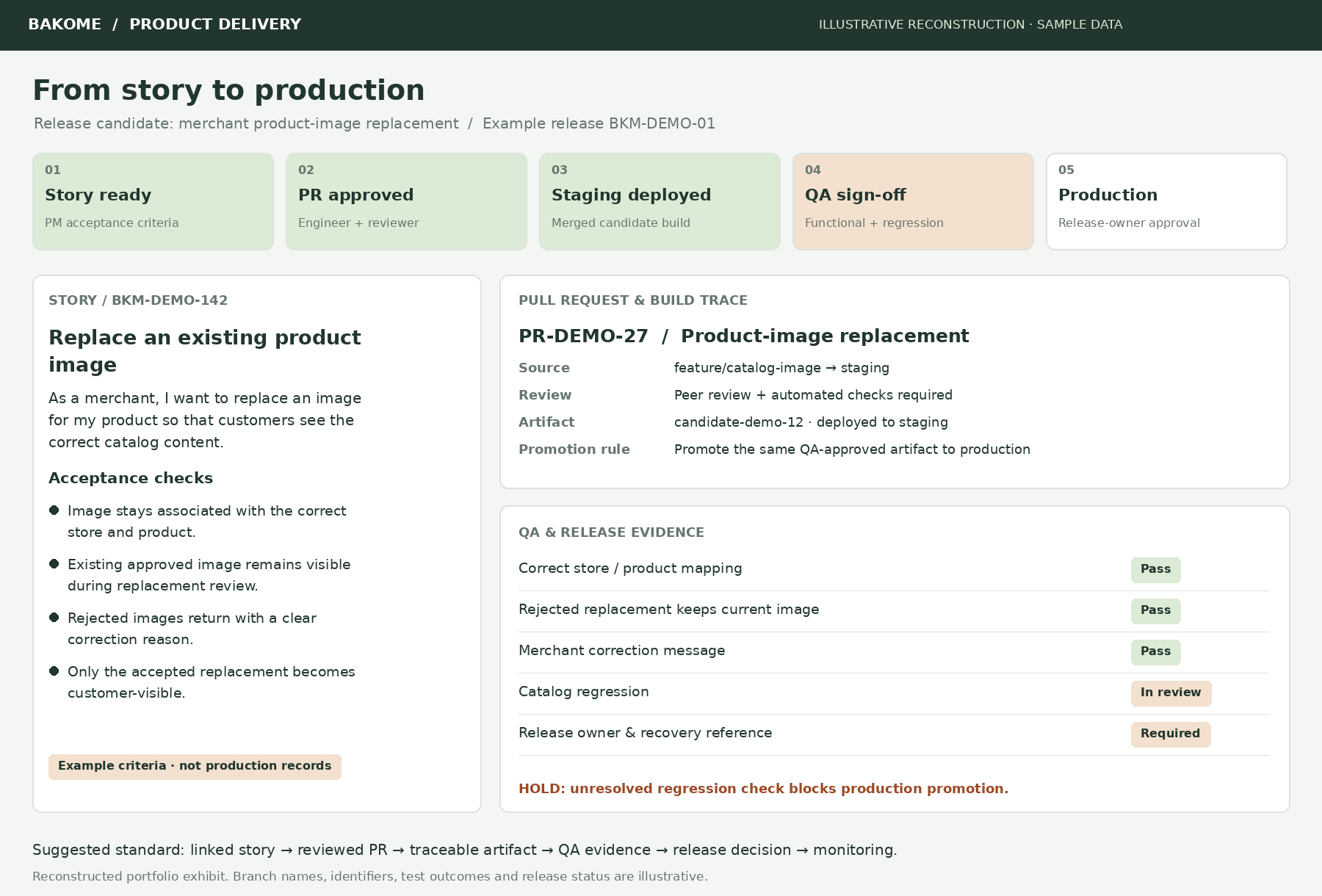
The proposed standard connects a customer need to acceptance criteria, engineering review, staging evidence, and a release decision. Every transition has an accountable owner and evidence required to proceed.
| Transition | Required evidence | Suggested accountable owner | Hold condition |
|---|---|---|---|
| Story → development | Problem, acceptance criteria, exceptions, dependencies, and scope boundary. | PM with engineering lead | A missing product decision would force engineering to guess. |
| PR → merge to staging | Linked story, peer review, passing checks, documented configuration changes. | Engineering reviewer | Review unresolved or required checks fail. |
| Staging → QA acceptance | Traceable candidate artifact; functional, permissions, and regression evidence. | QA owner with PM acceptance | Material failures or unverified acceptance criteria. |
| QA → production | Approved candidate, release owner, partner communication, recovery plan, and monitoring responsibility. | Release owner | Risk has no accountable decision, or the deployed candidate differs from the tested one. |
Maintenance mechanism: assign a standard owner, version the checklist, log the reason for each change, and publish the effective date. Review repeated exceptions during the improvement review.
Proportionality: use a short check for routine changes and more evidence for changes with higher uncertainty or customer impact. Keep product acceptance distinct from technical release approval.
These are proposed operating controls. They should not be read as verified BakOme branch-protection, test-automation, or approval settings.
04 / Operating cadence and launch planning
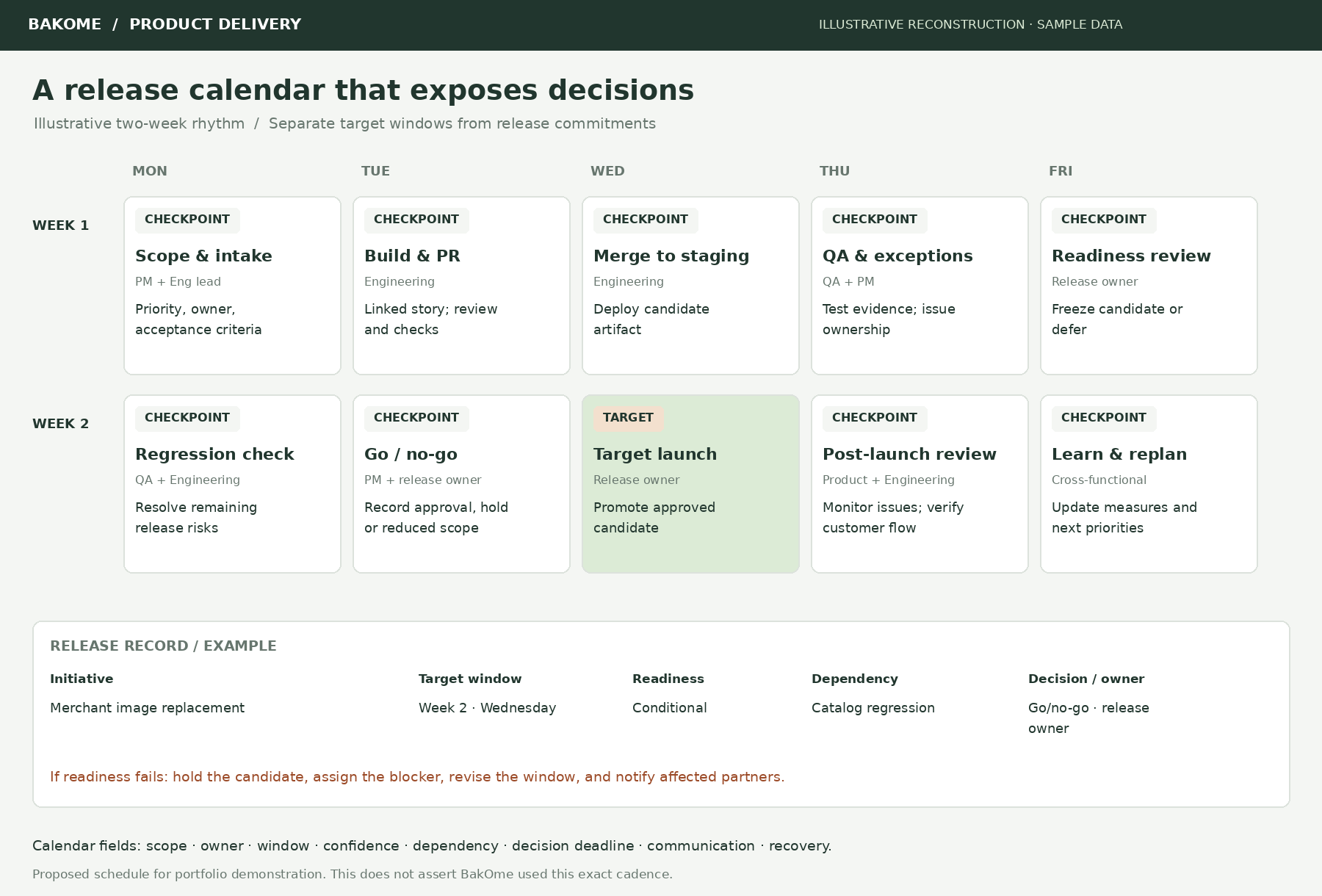
The release calendar provides a shared view of target windows. A go/no-go decision converts a target into an approved release only when the required evidence is available.
| Operating forum | Inputs to coordinate | Decision / output |
|---|---|---|
| Priority and scope review | Customer, store owner and driver needs; shared roadmap, capacity and dependencies. | What to build, investigate, defer, or stop; owner and next step. |
| Delivery and readiness review | Story status, PR/build evidence, QA exceptions, partner readiness. | Resolve blockers; revise scope or target window; assign escalations. |
| Launch go/no-go | Tested candidate, unresolved risks, communications, recovery ownership. | Release, hold, or reduce scope with a recorded rationale. |
| Post-launch learning | Order journey failures, support themes across all three personas, operating effort and outcome measures. | Follow-up improvements and changes to the delivery standard. |
These forums describe a proposed operating rhythm for the reconstructed example. Specific meeting frequencies and ownership are not asserted as historical achievements.
05 / Planning, OKRs, and leadership decisions
A leadership readout should expose cross-persona launch risk, its customer impact and the decision needed.
REPORTED ROADMAP DECISION / NOT YET A DELIVERY OUTCOME
Planning sequences the next work. An OKR review tests progress toward outcomes. A QBR brings outcome evidence, delivery constraints, and strategic choices together for leadership. They may share source data but need different agendas.
Grace’s PI and quarterly planning experience is at AFS. At Solovis, she formally reviewed OKRs and coordinated team metrics and product insights for QBRs and executive readouts.
06 / Evidence and learning
Reported local marketplace reach, not a daily-active-user measure.
Reported merchant base in Maryland.
End customers, store owners and drivers across the marketplace journey.
Customer: checkout-to-completed-order rate and issue resolution time. Store owner: acceptance time, readiness accuracy and order error rate. Driver: pickup wait, delivery completion and exception rate. Shared: cancellation reasons, end-to-end order time and support contacts per order.
These are proposed measures, not reported improvements. Baselines, event definitions and comparable cohorts are needed before attributing any change to the operating model.
FUTURE ROADMAP / PROPOSED OPPORTUNITIES
Future direction, not shipped functionality or committed delivery dates. Sequence and scope depend on evidence, technical fit and capacity. Pendo integration is a planned opportunity to evaluate.
Working hypothesis: software could enable coordination closer to local operators rather than require BakOme to build a centralized algorithmic capability first. This is an interpretation to validate, not a finalized architecture or commercial model.
Key decisions: who uses and pays for the software; who manages drivers, service promises and exceptions; and which shared data and standards maintain consistency across communities.
Pilot measures: assignment time, pickup wait, on-time delivery, support contacts per order and operator adoption. Define acceptable service thresholds before wider expansion.
Evaluate product analytics and targeted in-app guidance across customer, merchant and driver experiences.
Questions: Where do users abandon key tasks? Which features are adopted? Where do new users need help?
Decision gate: validate SDK compatibility, cost and event accuracy before wider rollout.
Use journey evidence to prioritize onboarding friction, order-status clarity, pickup coordination and driver-capacity visibility.
Measures: first successful task, assignment delay, pickup wait and delivery-promise accuracy.
Decision gate: demonstrate improvement without increasing cancellations or support burden.
Support the representative expansion plan with community-level demand, merchant readiness and driver coverage.
Measures: first-order conversion, repeat orders, on-time delivery and orders per driver-hour.
Decision gate: establish dependable service before widening the launch area.
| Persona | Journey to instrument | Decision supported | Potential in-app guidance |
|---|---|---|---|
| Customer | Store discovery → item selection → checkout → confirmed order; feature adoption and repeat visits. | Which step creates avoidable drop-off? | Contextual help for checkout or a newly introduced ordering feature. |
| Store owner | Store setup → catalog completion → availability setup → first accepted order. | What prevents a merchant from becoming ready to fulfill? | Setup guidance for catalog, images and order handling. |
| Driver | Onboarding → available status → assignment acceptance → pickup confirmation → delivery completion. | Where does a driver need clearer information or assistance? | Task-specific guidance before starting work or while safely stationary. |
Proposed instrumentation, not an assumption that every event is collected automatically. Product interaction data should be reconciled with authoritative order and dispatch records for operational outcomes.
Agree event definitions, a stable identity scheme, role-based segmentation and ownership of dashboards. Test completeness, duplicates, timestamps and app performance before using the data for decisions. Avoid sending payment details, precise delivery addresses or unnecessary personal information in analytics metadata.
Start with one meaningful funnel and a baseline. Assess whether the resulting insight changes a product decision; evaluate any guide against task completion, support contacts and dismissal rates. Set targets after the baseline is established.
Pendo supports analytics and in-app guides on web and supported mobile frameworks; fit and entitlement require validation. Pendo implementation options ↗ · Mobile implementation planning ↗
Grace Bakalag / Selected work